Poetry You Can See: REELpoetry 2026 in Houston
From the hands of Deaf poets to the voices of Texas, a hybrid festival that turned poetry film into a community and kept the conversation alive online
A critical review by the Institute for Experimental Arts, Athens
There is a particular kind of attention that poetry film demands. It asks the eye to listen and the ear to see. In Houston this September, REELpoetry 2026 practiced that double attention not only on the screen but in the way it built its rooms, its audiences and its communities. Founded and directed by Fran Sanders, the festival ran from September 18 to 25 in a hybrid form: two days of live screenings, readings and performances in Houston, followed by five days online, with the entire programme remaining available on demand until November 15. What emerged was less a showcase than a map of how poetry moves today, between languages, between bodies, between a local neighbourhood and the rest of the world.
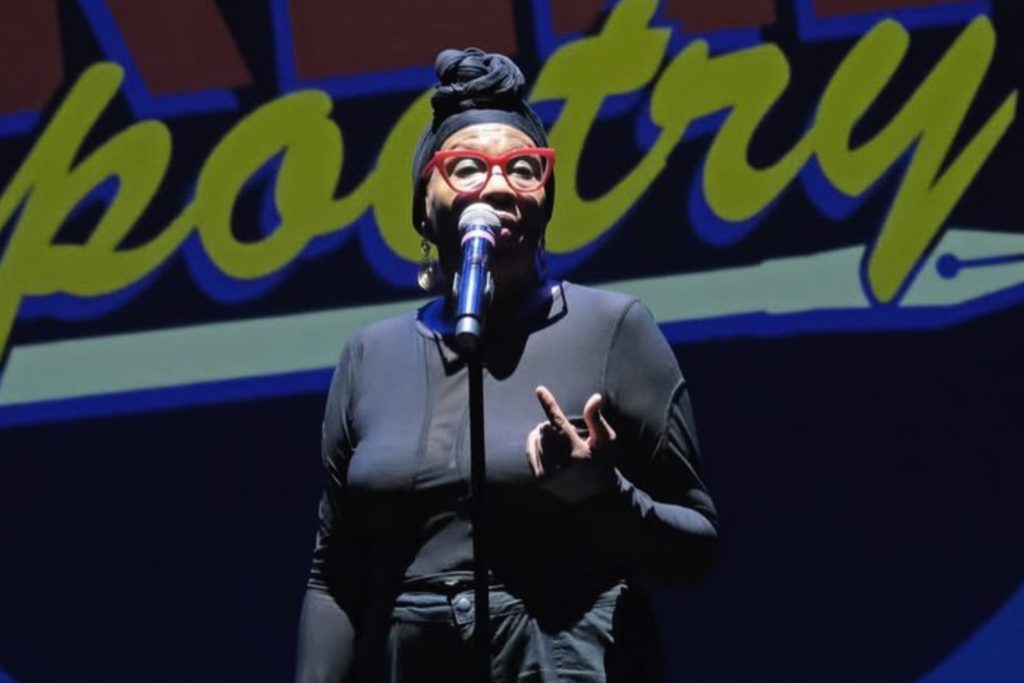
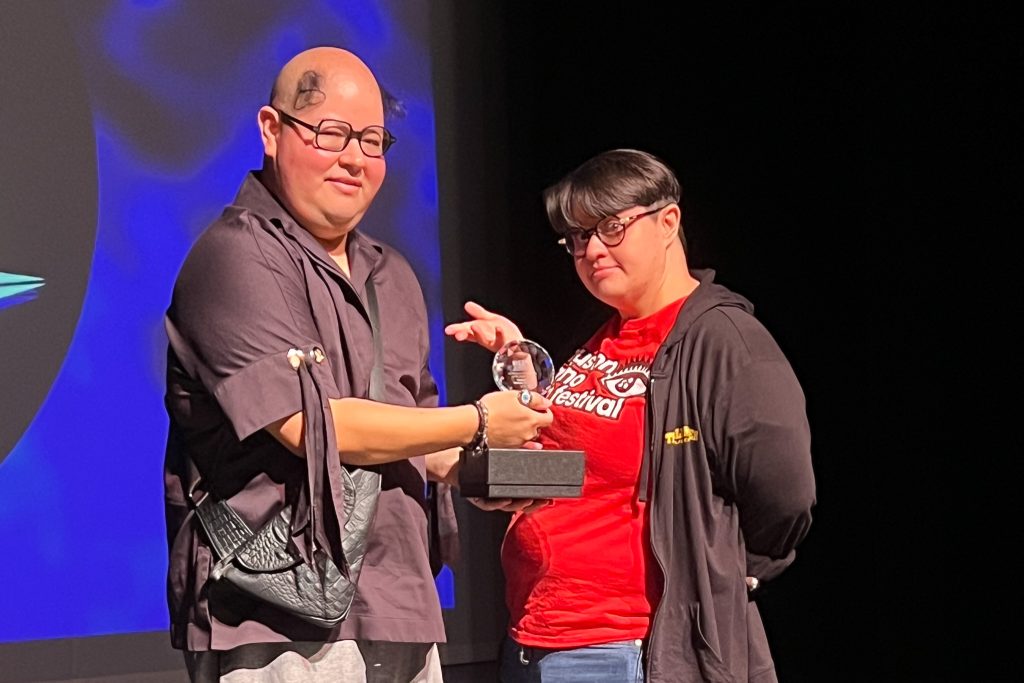
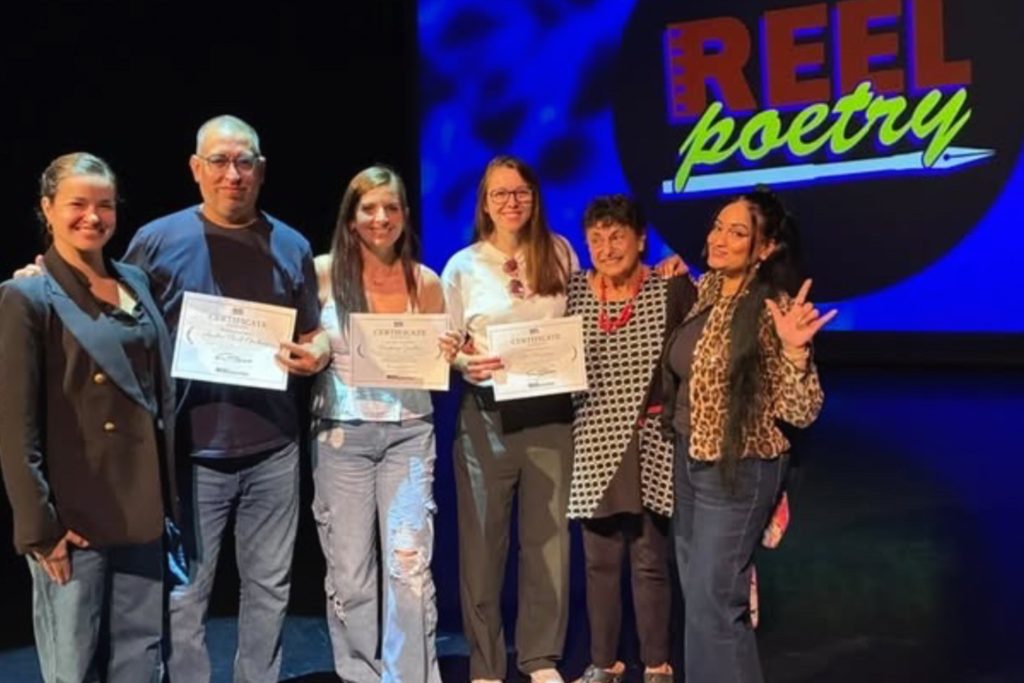
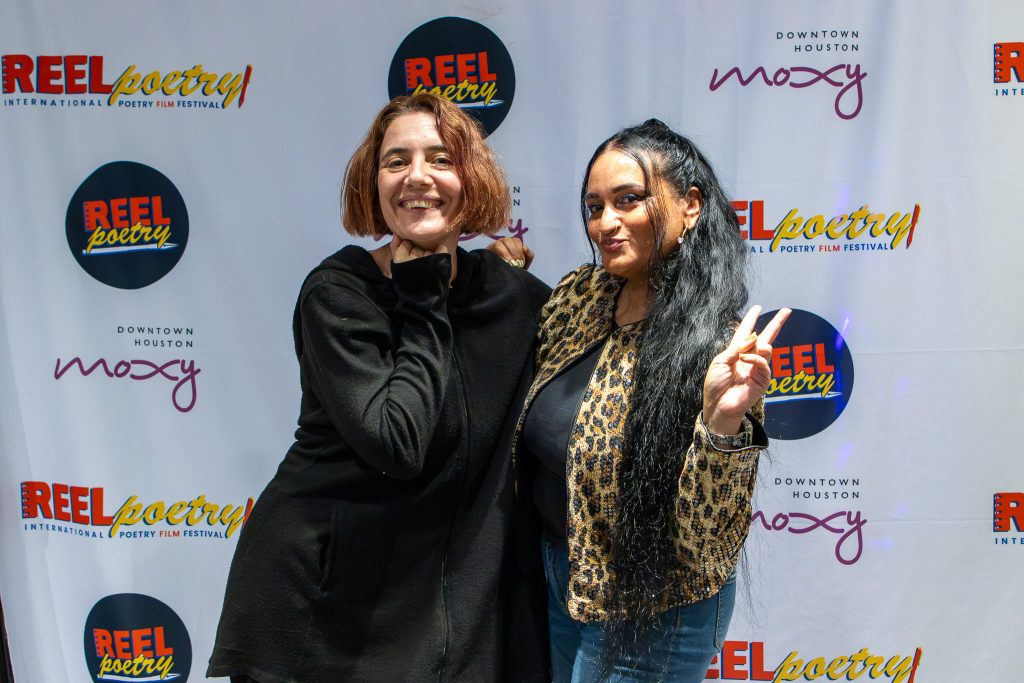
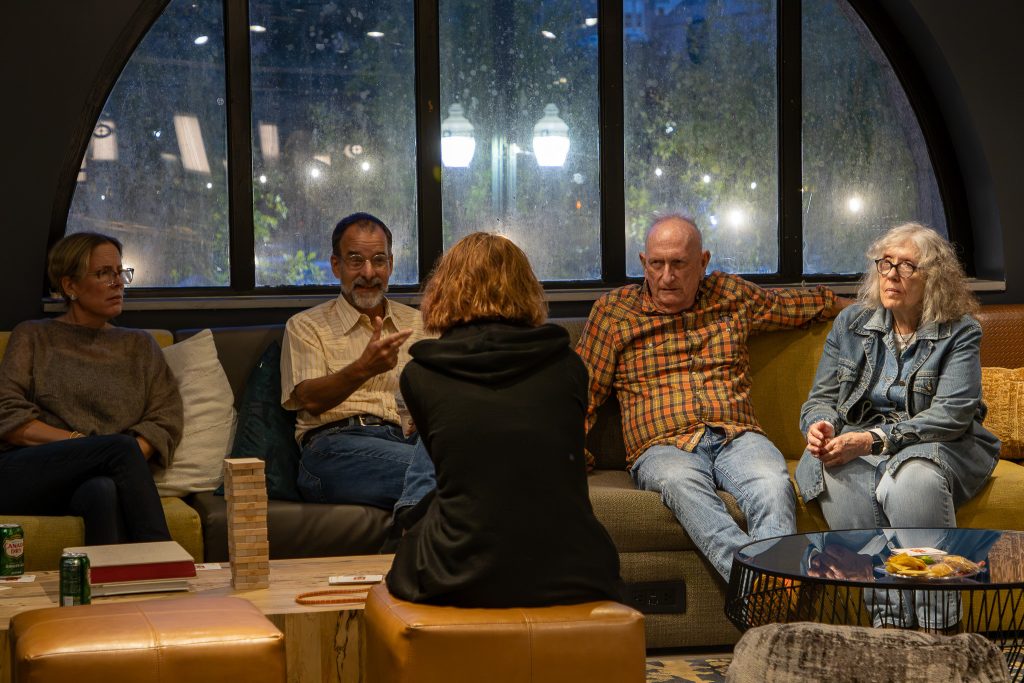
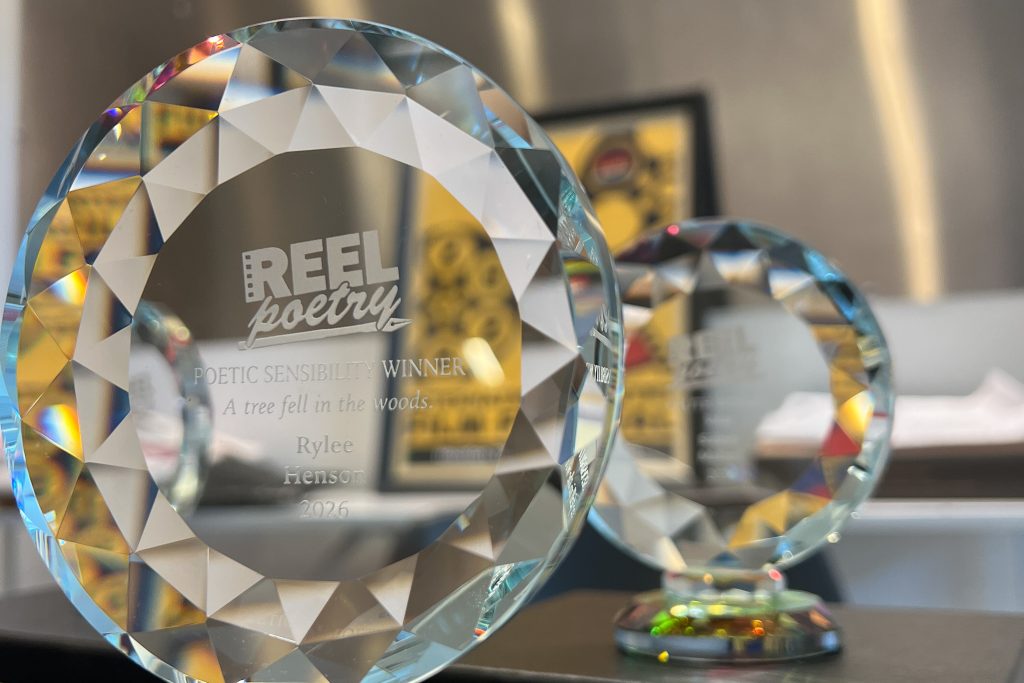
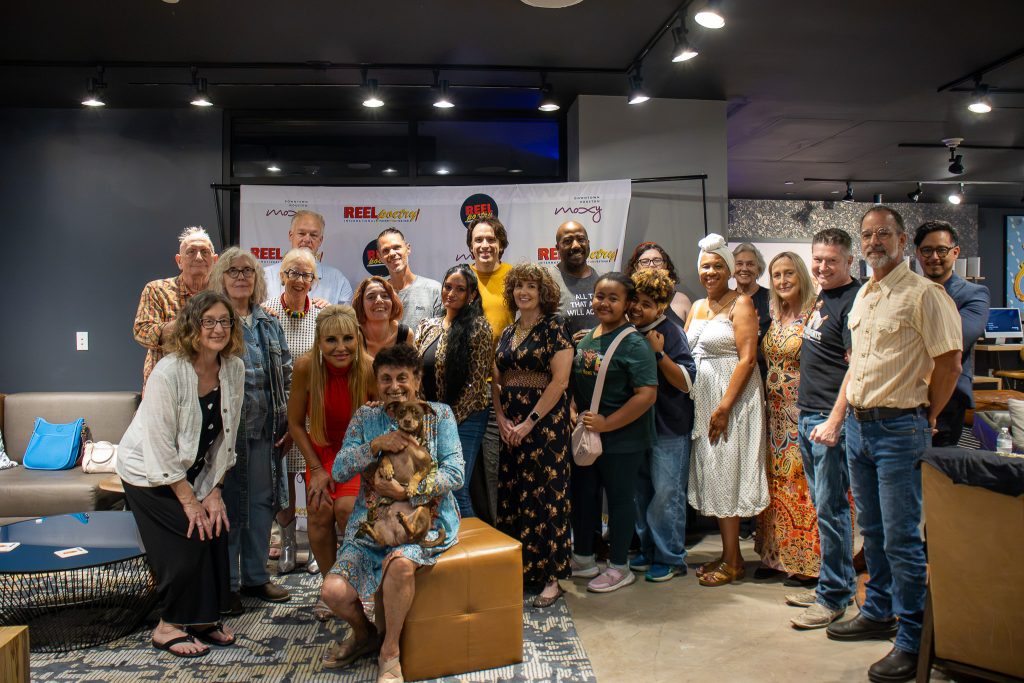
The atmosphere in Houston was warm and unpretentious. On the tables, programme booklets wrapped in a filmstrip collage of stills from the selected films. On stage, a single poet at the microphone, standing in a circle of light beneath the festival’s deep blue screen. Between screenings, poets, filmmakers, organisers, families and children crowded together in the lounge of the festival hotel, along with at least one small dog, for a group photograph that said more about this festival than any catalogue could. Crystal awards caught the light at the ceremony, among them the Poetic Sensibility award for Rylee Henson’s A tree fell in the woods., and certificates passed from hand to hand among winners who had travelled from near and far.
From the first hour at MATCH Houston it was clear that this festival is run with real care. The venue suited the work, every artist was presented with attention, the sound and the image were excellent throughout, and the organisation was flawless. Each participant was looked after as a guest, not processed as a name on a schedule. That care carried over into the programme itself, which was existential, socially and politically engaged, and deeply sensitive to questions of freedom and human rights. For an institute like ours, which has spent years building a video poetry community in Athens, it felt like arriving at a house where we already belonged.
Texas speaking for itself
The festival opened with a poem that refused to be abstract. Marie Brown’s When a Black Woman From 5th Ward Dials 911, filmed by Weldon Armelin, confronts the dioxin contamination that has poisoned Houston’s 5th Ward, and it set the tone for everything that followed: here, poetry film is a way of naming a place and the harm done to it. Later the same afternoon, Houston poet Chris Wise and filmmaker Matt Mullins presented Joseph Merrick, a crown of sonnets on the life of the man the Victorian world labelled the Elephant Man, a thirteen-minute meditation on how a body becomes a spectacle and how language might give it back its dignity.
The evening’s Made in Texas programme was one of the most intelligently structured sessions of the festival. Austin’s Outlier Moving Pictures, Pam Falkenberg and Jack Cochran, worked with Texas Poets Laureate Octavio Quintanilla and Emmy Pérez and with Houston poets Jane Creighton and Aliah Lavonne Tigh. Each poem was presented twice: first as a recorded spoken poem, then as a film. This simple gesture turned the screening into a lesson in translation, letting the audience hear the poem in the poet’s breath before watching it become image, rhythm and montage. Titles such as Poem Where the Violence Occurs Backstage and A Dam Is a Form of Failed Diplomacy carried the weight of the border, of water, of policy, without ever becoming slogans.
On Sunday, Greetings From Greater Houston, hosted by Alex V, gave the floor to local poets and filmmakers reading and screening their work: Koomah’s raw Let The Screams Be Seen, Laurie Clements Lambeth’s Field of Vision, Fabián Castro’s INSTANTANEAS, Emmanuel Zapata Jr.’s Play, Federico Bocanegra Monsalve’s Whitman-inflected Have you reckon’d the earth much?. What struck us was the plurality of voices, coming from many communities, histories and languages. Houston did not present itself as a single identity but as a crossroads, which is exactly what it is. The online Texas Roundup later gathered these works together again, so that the local scene could be seen by viewers far beyond Texas.
Deaf creativity: the poem in the body
For us, the heart of REELpoetry 2026 beat on Sunday morning, in ASL Poetry and Deaf Creativity, curated by Sabina England and Heba Toulan. This was not an accessibility add-on. It was a programme that challenged the very definition of poetry film, a form that so often relies on voiceover and the sound of the spoken word. Here the poem lived in the hands, the face, the whole body in space.
Willy Conley’s A Visual Meditation on Natural Gestures 2 opened the session, a contemplative study of how meaning already lives in gesture before any language is formalised. Christina Cox’s handshape poetry and Peter Cook’s Flying Words and Visual Vernacular pieces showed how ASL poetry composes with movement the way a filmmaker composes with cuts and camera angles: close-ups, slow motion, transformation, all performed by a single body. Sahera Khan’s I Don’t Care If It Is Repeated brought British Sign Language into the conversation, while Tonique the Signstress’s ASL rendition of TLC’s Baby Baby Baby reminded us that Deaf culture also claims pop, rhythm and joy. Music videos by Defstar, Sho’ Roc and Aarron Loggins, Brandy Mimms’s dance video, Sabina England’s own Daydreaming of Aliens (And You) and Aaron “Aaronic” Scott’s The Man with the Book of Creations widened the frame further.
The most moving moment was a dialogue across generations: Lewis Carroll’s Jabberwocky performed in 1967 by Joe Velez, then again in 2020 by Zain Ahmed and Jerald Creer. A nonsense poem, built entirely on the music of invented words, becomes in sign language something entirely new: a visual play of invented forms, a choreography of imagination. Seeing these two versions side by side was to witness a living tradition, with its own history, its own pioneers and its own future. The session closed with Andrés “Flash” Otalora’s short film [BLEEP] ’EM. Interpreted into spoken English and with all ASL videos subtitled, the programme invited hearing audiences in, without ever asking Deaf artists to translate themselves into a hearing aesthetic.
It matters, too, that Willy Conley’s film also appeared in the online Video Jukebox alongside works from Ireland, the UK and Canada. Work by Deaf artists was not kept in a separate room; it travelled through the general programme. We hope future editions will push this further and place Deaf creativity at the centre of the evening programmes, because this is where some of the most radical thinking about image and language is happening today.
Of everything we saw in Houston, this section is the one we admired most, and the one we most want to carry home. We hope to collaborate with these poets in the future and to invite them to Greece, so that their work can meet new audiences and so that the conversation between sign language poetry and video poetry can continue on the other side of the Atlantic.
An international conversation
Around these two poles, the festival opened windows onto the world. Lucy English introduced a jukebox of films by previous REELpoetry curators. Belgian filmmaker Marc Neys, known as Swoon, received a retrospective, Cheap and Fast, celebrating a fiercely independent practice built on speed and creative momentum. Charles Olsen and Lilián Pallares presented Palabras Prestadas | Given Words, films born from poetry competitions in Spain and Aotearoa New Zealand, and mother and son Monique van Kerkhof and Bo Oudendijk brought Roads Connected, work made between the Netherlands and Japan. Sissy Doutsiou, co-director of the Institute for Experimental Arts, curated Paradise Now, a programme of films from Greece, Iceland, Mexico and Turkey about the space and time we need to overcome obstacles and historical trauma, and gave a live spoken word performance that evening, so we write this review from inside the festival as much as from the audience.
The festival continues online
What makes REELpoetry exceptional is that it did not end when the Houston doors closed. From September 21 to 25 the festival moved online, with every programme screened twice a day for different time zones, and each day closing with the REELcafé, a ninety-minute live Zoom where audiences, poets, filmmakers and judges talked about the films they had just seen, hosted by Fran Sanders. The online edition carried all the juried selections, chosen by an international panel of five judges from England, Germany, Scotland and the USA, and the Best of the Fest winners, with remarkable videopoems such as Helen Wells’s FAST SLOOOOOW and I only spoke to see the tree, Polina Cosgrave’s Dublin Dust, Aaron Garcia’s Kaprekar’s Constant, Rylee Henson’s A tree fell in the woods. and José Crúzio and Martin Gerigk’s D. H. Lawrence film I was here.
The online programme also brought exclusive content: poetry films from Turkey created and curated by Tuğçe and Hugo Dervisoglou of Whirling Dervish Films, a selection from the Matwaala South Asian poetry collective curated by Usha Akella, Pramila Venkateswaran and Kashiana Singh, and Jazz Music of Victory, readings by displaced children in Odesa, Ukraine, through the Poems Not Bombs outreach in collaboration with the Red Nova Jazz Ensemble. Hearing children’s voices from a city under war, inside a festival dedicated to poetry, was a reminder of why this art form exists at all.
A community, not just a festival
REELpoetry 2026 proved that a poetry film festival can be both local and planetary, both rigorous and generous. It gave Texas poets the space to speak about their own land, gave Deaf artists the space to redefine what a poem can be, and kept the conversation alive online for weeks after the last live screening. In a time when so many cultural spaces are closing their doors, Houston opened several at once. We left with the feeling that we had not attended an event but joined a community, and that is the highest compliment we can give a festival.
The Institute for Experimental Arts, Athens